
Few in the UK farming industry will look back at the 2026 harvest with any great affection. It was, after all, one of the earliest, driest, and most challenging on record, heavily impacted by an extreme summer drought and record-breaking heatwaves.

The prolonged hot weather accelerated crop maturation and, according to the AHDB, national cereal yields dropped significantly below historic averages, with central, southern and eastern England hardest hit due to severe drought stress.
The silage cutting season was also badly affected. First-cut grass silage got off to an early start across parts of England and Wales by late March and April.
However, come the summer, heatwaves and drought caused grass growth to stall dramatically across the midlands, south-west and southern England, with some livestock farmers reporting grass growth down by up to 90%.
Heat stress in dairy cows caused a reduction in milk yields and slowed growth rates in beef and sheep, whilst the warm temperatures created favourable conditions for midges, causing a rise in bluetongue virus cases.
For many farmers, the extremely hot, dry, dusty conditions brought with it another unwanted headache.
Operators of tractors, combines, forage harvesters and other key self-propelled machines were forced to stop work in the field, often multiple times every day, in order to manually clear out radiators clogged up with dirt, chaff, seeds and debris.
The wasted hours and inconvenience at the busiest time of the year is bad enough, but blocked radiators also waste fuel – and lots of it – costing machinery operators a serious amount of money.
Blockages that impede radiator airflow trigger a chain reaction that increases fuel consumption in a number of ways.
When a radiator starts to get blocked the coolant temperature rises. This forces the fan clutch to fully engage or the fan to spin at maximum speed to pull air through the restriction. Spinning a heavy cooling fan at maximum RPM steals a substantial amount of horsepower directly from the engine, wasting fuel just to turn the fan.
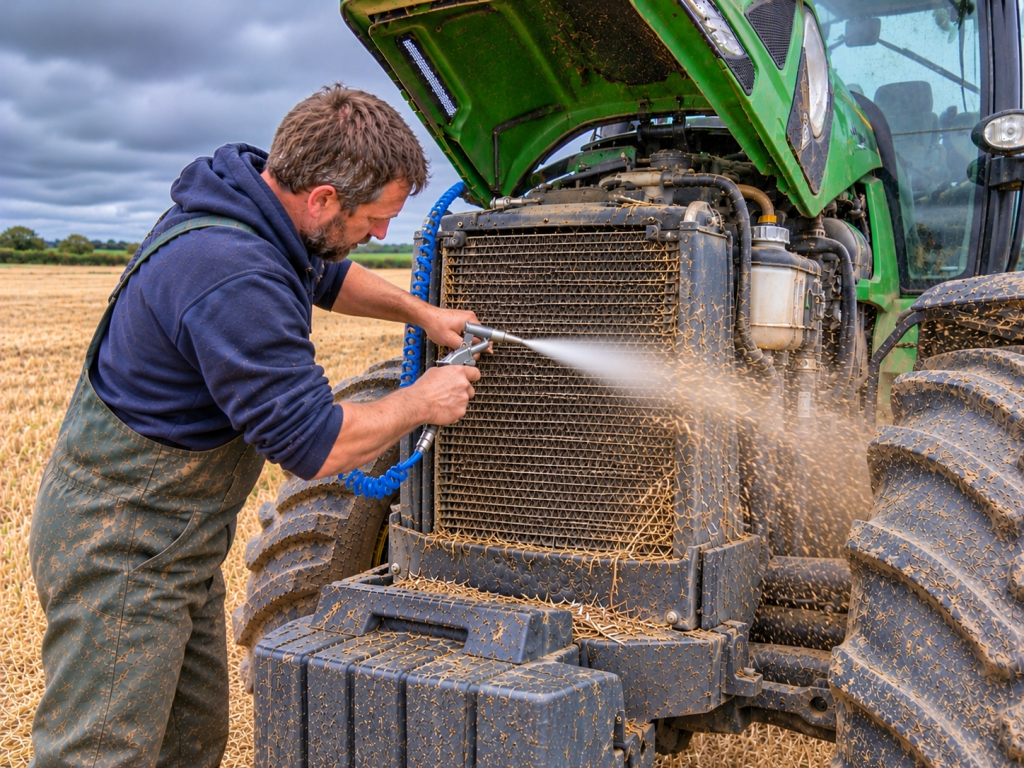
Severe radiator blockages can cause the diesel engine to run excessively hot and way outside its optimum temperature range. When this happens, the density of the incoming intake air decreases. Less oxygen in the cylinder leads to incomplete combustion, meaning you get less power per stroke out of every drop of diesel.
In ‘worst case’ overheating scenarios, today’s modern electronically controlled diesel engines will automatically reduce power output to protect the engine from catastrophic failure. To maintain your working speed while underpowered you are then forced to downshift or push the throttle harder, severely dropping your acres-per-gallon efficiency. Some ECU systems will even inject excess diesel fuel into the cylinders to prevent internal structural damage. This extra fuel isn’t burned for power; instead it is used as a coolant to lower the combustion chamber temperature via evaporation.
Tractors utilise hydraulic and hydrostatic transmission coolers, stacked directly in front of or behind the main engine radiator. When the airflow is blocked, the hydraulic fuel overheats and loses its viscosity. Hydraulic fluid that is too thin causes internal slippage in hydraulic pumps and hydrostatic drives. Because the fluid slips, the tractor has to work much harder to lift implements or maintain ground speed, requiring the engine to burn significantly more fuel to achieve the same physical output.

Quite simply, blocked radiators can greatly increase fuel consumption which in turn increases your costs substantially.
By way of an example, a 150hp tractor operating under a typical heavy workload can waste as much as 6 litres of fuel per hour due to severely restricted airflow.
With red diesel, at the time of writing, averaging around the 104p per litre* mark, that equates to £6.24 down the drain for every single hour that your tractor is running. That’s thousands of pounds wasted every year without factoring in the potential costs of engine and hydraulic system repairs or machine downtime. All because of a choked-up radiator.
One of the most effective ways to prevent radiator blockages is to install a reversible cooling fan such as Flexxaire. Unlike conventional fans, Flexxaire fans deliver only as much airflow as required, creating exponential fuel savings compared to conventional cooling packages or increasing productivity by freeing up power for your machine. At an average ambient temperature of 15°C, the Flexxaire fan’s power draw is reduced by 75%, resulting in significant savings in fuel consumption and operating cost.
Flexxaire reversing diesel engine radiator cooling and cleaning fans save fuel primarily by reducing parasitic power loss and maintaining optimum radiator efficiency.
Featuring fast pitch reversing, in under one second, a Flexxaire fan purges debris from the radiator, effectively cleaning the radiator system and keeping it operational at all times.
No more downtime for manual cleaning – you can programme the fan to purge at automatic intervals or do it from the cab at the touch of a button.
Variable airflow also prevents the underestimated harm that can be caused by over cooling and promotes efficiency and longevity of your engine. Flexxaire’s in motion variable pitch hub allows the fan blade pitch to be adjusted at any fan speed. The system understands exactly when and how the pitch of the blade should change to maximise your engine’s performance.
For a relatively modest outlay, and little or no machine downtime, installing a Flexxaire fan on your tractors and other business-critical, diesel-driven machinery will deliver an outstanding return on investment in terms of both time and fuel savings.
In addition, you’ll be protecting your engine against potentially serious long-term damage due to frequent or excessive overheating. And in so doing, you’ll also be protecting yourself against the not-unsubstantial cost and inconvenience of machine breakdowns at your busiest times of the year and the subsequent unscheduled downtime for repairs.
For more details about the Flexxaire range, take a look at our web page here or call us for further information and prices.
*As tracked by Farmers Weekly Fuel Prices at 18 November 2026.
Lynx Engineering is the UK importer for a wide range of machinery brands, distributed through our nationwide dealer network.